Handicrafts and gifts

Brand design for handmade jewelry and crafts

People pay for the hands, if they can see the hands.

Handmade jewelry, home decor and accessories are usually made by one or two people, then copied and compared with cheap goods. Sinh Vũ gives a brand a distinct character that is hard to copy: name, label, tag, box and a way of telling who makes it.

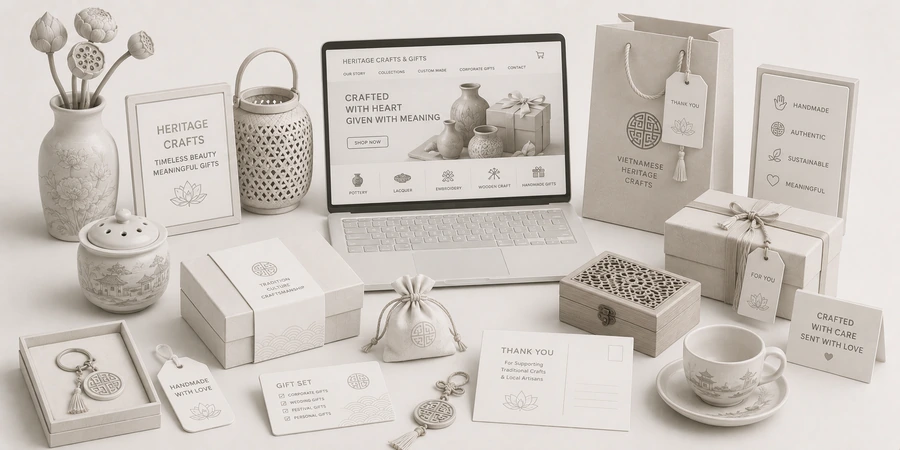
A set of sample pieces for a handmade brand: labels, tags, small jewelry boxes, a photo of the workbench and a sales page
Quick answer01

What does a handmade brand need?

Three things first: a name and mark that hold across many collections, a label and tag that go with every piece, and photos that show the workplace and the maker. Those three let customers recognize the product even after the design has been copied.

  1. A lasting name and mark

    Unchanged across collections, and small enough to engrave or stamp onto a product.

  2. A label and tag that go with each piece

    Naming the maker, the material and how to care for it: a small tag that says enough.

  3. Photos of the workbench and the maker

    The one thing a copycat has nothing to copy from.

Business types02

Three kinds of handmade goods, three problems

Jewelry, home decor and accessories are all made by hand, but customers see them in three places and in three different ways.

Handmade jewelry

Their customersYoung people and working professionals buying for themselves or as gifts, who study small details closely.

Brand challengeShow the material and the care at a small scale, in a small box that still feels like receiving a gift.

Home decor

Their customersPeople furnishing homes, cafés and homestays, who choose by taste and color.

Brand challengeHelp customers picture the piece in their own space, and recognize that the collections come from the same maker.

Handmade accessories

Their customersCustomers buying bags, wallets, scarves, leather and fabric goods, comparing against branded and factory goods.

Brand challengeThe label and tag say clearly why it is handmade, how long it took and how durable it is.

Pain points03

Four pain points specific to handmade brands

These are the places where a handmade brand loses customers and skill alone can't save it.

03

Boxes and tags ordered in small runs look different each time

Each order is a few hundred pieces, and switching printers shifts color and material; the next box doesn't match the last.

Settle one set of materials and a standard print file that works for small runs and survives a change of printer.

Start from this problem
Customer journey04

At which stage does a handmade brand lose the most customers?

At Notice. Customers scroll past very quickly on Facebook, Instagram and marketplaces. If a photo has no character of its own they keep scrolling, or stop at a similar piece from somewhere else.

Where customers are most often lostNotice
Do this now
  1. Choose one way of shooting (backdrop, light, composition) for every photo.
  2. Use the same profile picture, name and introduction everywhere you sell.
  3. Put the workbench photo at the top of the page, ahead of the mass-produced product shots.
Touchpoints05

Five touchpoints to do first

Touchpoints are the places where customers see, touch or hear about the brand. You don't need to do everything at once. These five touchpoints decide most of a customer's impression.

  1. Label, tag

    They go with every piece, and are the only place the maker gets to sign.

  2. Bag, box

    It is what the customer opens before touching the product.

  3. Workbench photos

    They show the hands and the process, the hardest thing to copy.

  4. Sales page

    Where the customer decides to buy, and where it is easiest to get lost among other goods.

  5. Social media and marketplace profiles

    Customers usually meet the brand here before they know its name.

Roadmap06

Where Sinh Vũ suggests starting

Listed in the order to do them. A solo maker can stop at step two or three; a brand with a team goes on to the end.

  1. Logo and Brand Identity Design

    Name, mark, color and type: the base for labels, tags, boxes and the sales page.

  2. Product packaging design

    Labels, tags, bags and small boxes that can be made in small quantities.

  3. Product and brand photography

    Product photos in one style, and photos of the workbench.

  4. Brand website design

    A sales page of your own, when the brand wants to hold customers outside the marketplaces.

  5. Brand guidelines handbook

    When others join in or collections are added: guidelines so everything keeps one character.

Projects07

Projects closest to modern handmade

Sinh Vũ has not published a modern handmade project. The two below solve the two closest problems: many product lines under one mark, and packaging made from deliberately raw materials.

Further reading08

More on modern handmade

Free toolTouchpoint map for this business modelSee the five stages customers pass through, where they drop off most, then rate the five touchpoints to fix first.Open the tool Free toolBox dieline makerEnter the inside length, width and height to draw a reverse tuck end or two-piece box dieline with cut and fold lines, ready to download as SVG and PDF for a mock-up.Open the tool
FAQ09

Frequently asked questions

It must read at a very small size, because it will be engraved or stamped on the product and printed in the profile picture. Sinh Vũ tests the mark at its smallest size before settling.

A brand helps customers recognize the original through its name, mark, voice and box, things that are hard to copy whole. For trademark protection, read the brand legal articles in our reference section or ask an intellectual property specialist.

Not necessarily. Selling on marketplaces and social media is enough at first. You need your own page when you want to keep customers and tell the story in full.

Choose few materials and few sizes, and settle a standard print file so a reorder matches the last one. Put the emphasis on the tag and the way the box opens instead of many complicated layers.

Tell the real process through a few specific details: how long it took, what was used, what happens when it goes wrong and is redone. Avoid grand lines about passion.

Tell Sinh Vũ about your handmade brand

A few lines about your products, where you sell and what is holding you back is enough. Sinh Vũ will read it and reply within one working day.