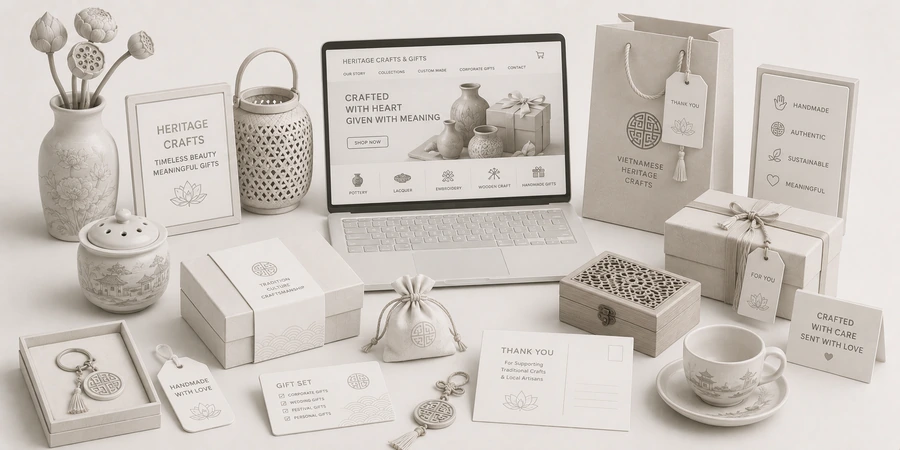
Handicrafts and gifts

Brand design for lacquerware and fine woodwork

Painstaking work is only worth something when the buyer can see it.

Lacquerware, wood carving and handcrafted furniture take weeks to finish a single piece, yet often get just one wide shot. Sinh Vũ helps a workshop show buyers the craftsmanship, the source of the timber and the maker's name.

A set of sample pieces for a craft workshop: a catalog with close-ups of lacquer layers, a specification page, a workshop mark and a fair booth
Quick answer01

What does a lacquer and fine woodwork brand need?

Three things first: a set of detail close-ups showing the lacquer layers, the carving and the joints; a catalog with sizes and how to order; and a plain statement about the timber and materials. Those three let a bulky piece still be chosen through a screen.

  1. Detail close-ups

    Lacquer layers, knife marks, joints: the things customers can't touch from afar.

  2. A catalog for buyers

    One page per design: size, materials, time to make, how to order.

  3. A plain statement about the timber

    Say only what the workshop has papers to prove; leave out what it doesn't have.

Business types02

Three kinds of fine craft, three problems

All are wood and finish, but lacquer paintings, wood carvings and furniture are viewed and ordered in three different ways.

Decorative lacquer

Their customersPeople hanging paintings and ordering decor for homes, hotels and offices; visitors.

Brand challengeHelp buyers understand why a lacquer panel takes many layers and many weeks, and trust it from a photo.

Carved wood

Their customersWood collectors, restaurants, hotels and places of worship ordering statues and reliefs.

Brand challengeShow the carver's hand and the knife lines, so the work isn't seen as mass-produced woodwork.

Handcrafted furniture

Their customersHomeowners, architects, interior contractors and foreign buyers.

Brand challengeState size, materials, joinery, time to make and delivery, so buyers can order without visiting the workshop.

Pain points03

Four pain points specific to craft workshops

These are the places where a craft workshop loses customers and craftsmanship alone can't save it.

02

Selling through middlemen, and the workshop name fades

Goods pass through agents; the final buyer doesn't know which workshop made them, and the workshop doesn't know who bought.

A workshop mark carved or written on the back of each piece, an accompanying tag, and a page where buyers can find the workshop again.

Start from this problem
03

Buyers ask about the timber and the workshop answers differently each time

A buyer asks where the wood comes from and whether the finish meets requirements; the answer is spoken, and varies from one time to the next.

Gather it into one short file page: timber species, source, the papers the workshop holds. Leave out whatever it doesn't have.

Start from this problem
Customer journey04

At which stage does a craft workshop lose the most customers?

At Buy. The goods are large and ordered from afar, so buyers need clear specifications, timber source and delivery time before they decide.

Where customers are most often lostBuy
Do this now
  1. Make a specification page for each design: size, materials, time to make.
  2. Put detail close-ups next to the photo of the piece in a room.
  3. State clearly how it is packed, delivered and cared for.
Touchpoints05

Five touchpoints to do first

Touchpoints are the places where customers see, touch or hear about the workshop. You don't need to do everything at once. These five touchpoints decide most of a customer's impression.

  1. Detail close-ups

    It is where buyers look for proof of the craftsmanship.

  2. Catalog

    It is what buyers keep, pass on to others and compare.

  3. Buyer's file

    It answers once and for all the questions about timber, materials and the workshop's capacity.

  4. Workshop mark on the back of the piece

    So the piece keeps the maker's name as it passes through many hands.

  5. Fair booth

    It has a few seconds for a passerby to understand what the workshop makes and what sets it apart.

Roadmap06

Where Sinh Vũ suggests starting

Listed in the order to do them. A workshop selling at home can stop at step three or four; one going to fairs abroad goes on to the end.

  1. Logo and Brand Identity Design

    Name, workshop mark, color and type: the base for the catalog, the file and the booth.

  2. Product and brand photography

    Detail close-ups, photos of the making process and photos in a room.

  3. Sales and marketing collateral design

    A catalog and a specification page for each design.

  4. Corporate capability profile design

    A company profile, timber source and materials file for buyers.

  5. POSM and event booth design

    A fair booth that tells the workshop's craft in a few seconds.

Projects07

Projects closest to lacquer and fine woodwork

Sinh Vũ has not published a lacquer or fine woodwork project. The two below solve the two closest problems: making buyers trust that a piece is valuable, and choosing materials with intent.

Further reading08

More on fine woodwork and lacquer

Free toolTouchpoint map for this business modelSee the five stages customers pass through, where they drop off most, then rate the five touchpoints to fix first.Open the tool Free toolBox dieline makerEnter the inside length, width and height to draw a reverse tuck end or two-piece box dieline with cut and fold lines, ready to download as SVG and PDF for a mock-up.Open the tool
FAQ09

Frequently asked questions

Draw it from the workshop's own technique: polished grain, lacquer layers, inlay, knife marks, rather than the familiar images every workshop uses. Sinh Vũ tests the mark small in a profile picture and large on a signboard.

For every design: a wide photo, a close-up, size, materials, time to make and how to order. If you sell to foreign buyers, you need a bilingual version.

State only what the workshop has papers to prove. Some foreign buyers require timber certification, so leave out whatever you don't have yet, and ask the certifying body what is needed.

One message, a few representative pieces, a catalog and a contact card. A small, clear booth is remembered more than a large, muddled one.

That customers can't touch the piece. You need close-ups, clear specifications and clear delivery and return terms, so they can order without visiting the workshop.

Tell Sinh Vũ about your workshop

A few lines about the workshop, the product line and what is holding you back is enough. Sinh Vũ will read it and reply within one working day.