Travel and accommodation

Brand design for places and tourist destinations

A destination is remembered when the whole place says one true thing about itself.

Generic slogans and many parties who struggle to agree are the two things that make a destination fade. Sinh Vũ helps provinces, cities and tourist areas find their real identity, then builds the identity system and the toolkit that local businesses can all use.

A sample identity set for a destination: local emblem, attraction wayfinding signs, a toolkit for businesses and promotional collateral
Quick answer01

What does a destination brand need for the whole place to share it?

Three things: a real identity drawn from the place itself, an identity system lean enough for every party to use, and a toolkit for local businesses and agencies. A destination has no single owner, so the brand only lives when many parties are willing to use it.

  1. A real identity

    Something true of this place that others don't have, recognized by residents and businesses alike.

  2. A lean identity system

    A mark, color and type that work on a large sign and on a small label on a local product.

  3. A toolkit for many parties

    Templates and guidance so local businesses, agencies and associations can use it on their own without drifting.

Business types02

Three kinds of destination brand, three problems

Scale, shared users and how long the brand has to live all differ, so the method differs too.

Provincial and city brands

Their customersVisitors, investors and residents; many agencies using it together.

Brand challengeFind something broad enough to embrace the whole place yet still its own, and lasting enough to outlive several terms of office.

Tourist area brands

Their customersVisitors coming to relax and sightsee; many businesses operating in the same area.

Brand challengeLet guests see the area as one unified place, even though the properties inside belong to many owners.

Regional promotion campaigns

Their customersPotential visitors far away who don't know much about the region.

Brand challengeOne shared message clear enough for every party to tell without stepping on each other.

Pain points03

Four pain points specific to destination brands

These are the places where destinations tend to fade even when the scenery and culture are rich.

Customer journey04

At which stage do destinations lose the most visitors?

At the Dream stage. Visitors see beautiful photos and videos but don't remember the name of the place, or find nothing that makes them choose this one over another.

Where customers are most often lostDream
Do this now
  1. Settle one thing that is the place's own and repeat it consistently across every campaign.
  2. Share one set of imagery and marks so every photo evokes the name of the place.
  3. Give local businesses a ready-to-use set of templates so they all repeat the destination's name.
Touchpoints05

Five touchpoints to do first

Touchpoints are the places where visitors and local businesses see the brand. You don't need to do everything at once. These five touchpoints decide most of whether the brand gets used.

  1. Destination brand guidelines

    The document that lets every party use it correctly without asking each time.

  2. Emblem and identity system

    It has to work at very large sizes on signs and very small sizes on local product labels.

  3. Wayfinding signs and visitor pickup points

    Where visitors first meet the brand in person.

  4. Promotion campaign

    Where the identity is told as a story to people far away.

  5. Toolkit for local businesses

    Turns the brand from the agency's into the whole place's.

Roadmap06

Where Sinh Vũ suggests starting

Listed in the order to do them. Finding the identity and aligning the parties must come first, because doing it backward often means fixing things after they are printed.

  1. Brand strategy and positioning consulting

    Find the destination's real identity and position from the place's own evidence.

  2. Brand working session for the team

    Bring the parties to one table to agree on what will be said together.

  3. Logo and Brand Identity Design

    An emblem, color and type for the destination, tested at both large sign size and small label size.

  4. Brand guidelines handbook

    Guidelines and a file set so local businesses and agencies use it correctly.

  5. Advertising campaign image design

    Campaign imagery to tell that identity to people far away.

Projects07

Projects closest to destination branding

Sinh Vũ has not published a provincial or destination brand project. The two below are closest in the problem of one shared face that many parties use, tied to a place.

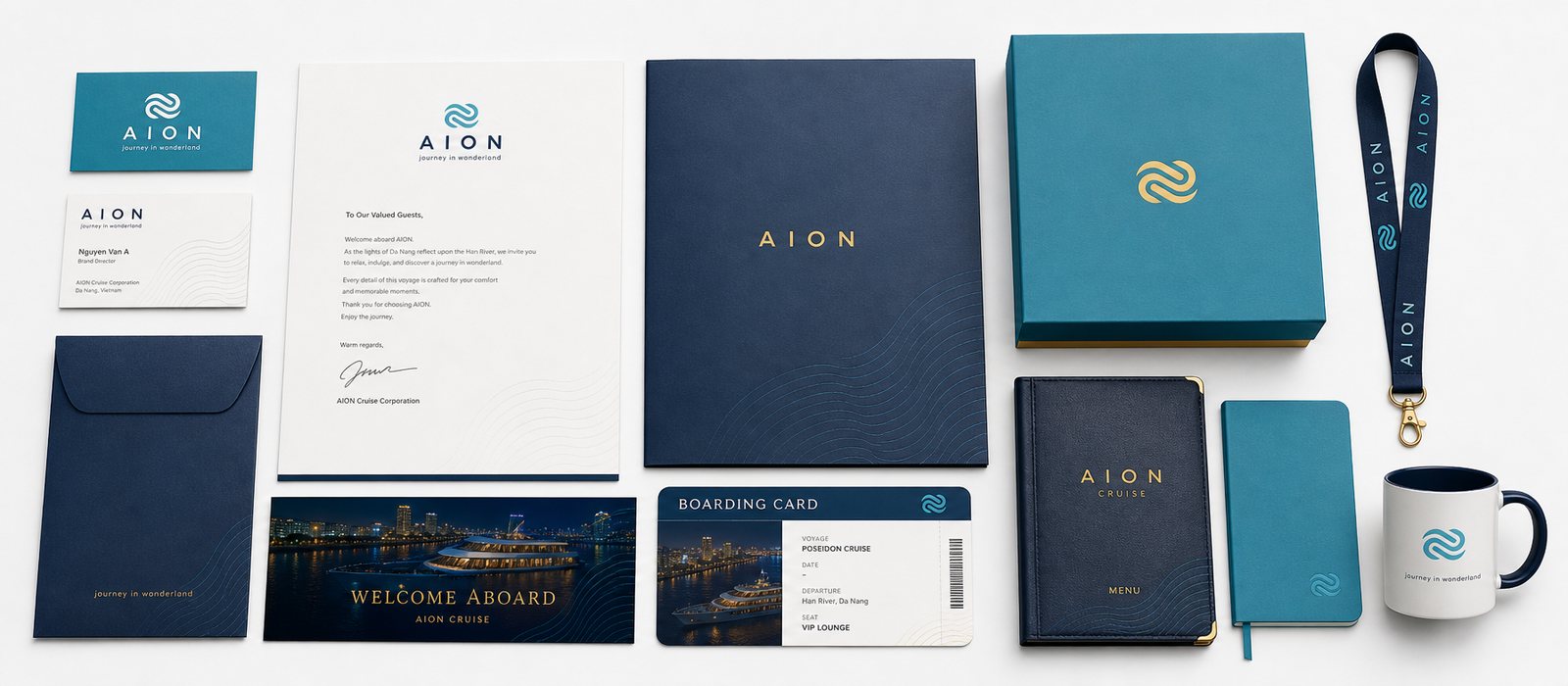
AION, one continuous flow
Cruise tourism

AION, one continuous flow

A refined identity system for the parent company of the Hàn River cruise fleet in Đà Nẵng, with Poseidon leading as the five-star flagship…

View case

One shared voyage on the Han River in Đà Nẵng for the whole fleet: a parent name that has to embrace many parties while still giving room to the bright spots, like a locality with many units.

Further reading08

More on destination branding

Free toolTouchpoint map for this business modelSee the five stages customers pass through, where they drop off most, then rate the five touchpoints to fix first.Open the tool Free toolBrand name checkType a brand name to see whether it is easily misspelled over the phone, its version without accents, the domain and initials, with trademark search links ready.Open the tool
FAQ09

Frequently asked questions

A logo is only one part. A destination brand includes the identity, the message, the identity system, how to use it and a toolkit for many parties. Without the later parts, the logo just sits in a file.

Give them a reason and an easy way: an identity they recognize as their own, a ready-to-use file set and short guidance. The brand has to lighten their work, not add to it.

Start from one thing only this place has, then try the line on another place: if it still fits, it isn't specific enough. A good slogan has to evoke the name of the place.

Use a structured workshop and put evidence and visitor feedback on the table instead of personal opinion. Settle what is common first, and leave each party's own parts for later.

There is no general number. Sinh Vũ hands over a clear identity, an identity system and a full toolkit; the effect also depends on whether the parties keep using it together.

Tell Sinh Vũ about your destination

A few lines about the place, the parties involved and what is holding you back is enough. Sinh Vũ will read it and reply within one business day.