Logistics and transportation

Brand design for warehousing and fulfillment companies

Clients hand their goods and their reputation to a warehouse whose inside they have never seen.

Businesses choose a warehousing partner through a profile, a website and a warehouse visit. Sinh Vũ turns the capability inside the warehouse into something clients can read: clear processes, clear figures, tidy images.

Sample collateral for a warehousing company: company profile, warehouse directional signs, zone labels and an inventory report template
Quick answer01

What does a warehousing company brand need?

Three things first: a company profile that leads with what clients ask, a website that shows the real warehouse, and a periodic report template that reads fast. Those three decide whether clients trust you with their goods.

  1. A profile that leads with what clients ask

    Processes, systems and clients served, written for decision makers to read in a few minutes.

  2. A website that shows the real warehouse

    Real warehouse photos, the inbound and outbound process and certifications, easy to find, instead of stock images.

  3. A periodic client report

    Report templates for inventory, orders processed and discrepancies, quick to read and carrying the company's face.

Business types02

Three kinds of warehousing, three problems

All of them store and process goods, but the clients differ, so what the brand has to say differs too.

Warehousing and fulfillment

Their customersE-commerce sellers and brands that need storage, packing, order delivery and returns handling.

Brand challengeShow clients how an order moves through the warehouse, step by step, and who is responsible at each step.

Cold chain and cold storage

Their customersFood, seafood and pharmaceutical producers and distributors who need goods held at a defined temperature.

Brand challengeTurn hard-to-read technical capability, like temperature range and monitoring, into something decision makers understand and trust.

Third-party logistics

Their customersBusinesses that hand their whole warehousing, transport and paperwork operation to one partner instead of doing it themselves.

Brand challengeState clearly what you take on across a chain, without sounding like you promise everything to everyone.

Pain points03

Four pain points specific to warehousing

These are the places where warehousing companies lose clients that strong internal systems can't save.

Customer journey04

At which stage do warehousing companies lose the most clients?

At the Evaluate stage. Clients compare a few warehouses through profiles, websites and warehouse visits before talking further. The one that shows its capability most clearly gets invited back to the table.

Where customers are most often lostEvaluate
Do this now
  1. Open the profile with what clients ask most, and only then list equipment.
  2. Have a warehouse tour route ready: where to walk, what to say, what the client takes home.
  3. Include two or three real operating figures with how they are measured, and don't promise numbers you don't have yet.
Touchpoints05

Five touchpoints to do first

Touchpoints are where clients see, read or hear about your company. These five go first because clients use them to decide whether to move into your warehouse.

  1. Company profile

    Often the first thing clients take away to compare warehouses.

  2. Website

    Where clients look at the process and warehouse photos before booking a visit.

  3. Warehouse tour route

    Shows clients the capability inside in a single session.

  4. Warehouse signs and zone labels

    Tell visiting clients that everything is in order.

  5. Client reports

    Read regularly and the living proof of your operating standards.

Roadmap06

Where Sinh Vũ suggests you start

In the order Sinh Vũ would do them. A new warehouse can stop at step two or three; a company with many warehouses goes all the way.

  1. Brand strategy and positioning consulting

    Pick the warehouse's real strength as the opening line for everything after.

  2. Logo and Brand Identity Design

    Name, mark, color and type for the profile, warehouse signs and reports.

  3. Corporate capability profile design

    The company profile and a periodic report template for clients.

  4. Brand website design

    A website that tells the process and shows the real warehouse.

  5. POSM and event booth design

    Warehouse signs, zone labels, safety vests and packing supplies.

Projects07

The projects closest to warehousing

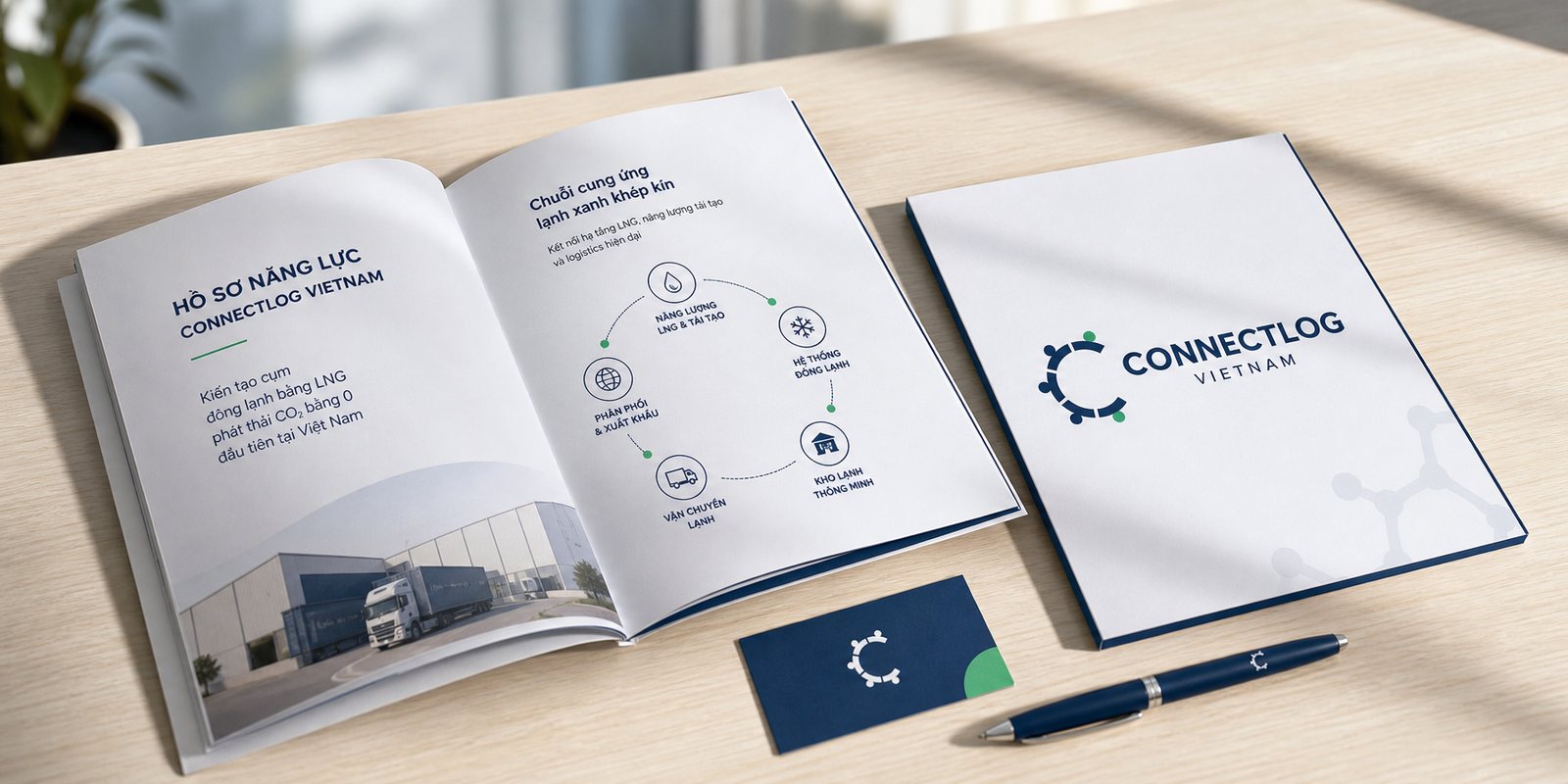
ConnectLog is a cold chain project, exactly this segment, but as a fundraising profile for a cold storage cluster, not an operating warehouse company. Chigasoco is an invisible trade right next door.

ConnectLog, a cold chain worth telling
Cold-chain logistics

ConnectLog, a cold chain worth telling

At the port, most of the cold energy from LNG is returned to the sea. ConnectLog saw in that discarded stream an entire value chain…

View case

A cold chain told from engineering drawings to the investor's table: settle the standing first, sit with the founding team to draw out why now and why them, and only then build the profile.

Chigasoco, made simple
Sourcing services

Chigasoco, made simple

Chigasoco, a sourcing company, needed a face as clean, clear and trustworthy as the invisible trade it runs; Sinh Vũ built its visual identity and corporate stationery.

View case

An invisible trade needs a visible face: a compact promise placed on contracts, parcels and booths. Warehousing also sells what clients can't see.

Further reading08

More on warehousing and cold chain

Free toolTouchpoint map for this business modelSee the five stages customers pass through, where they drop off most, then rate the five touchpoints to fix first.Open the tool Free toolTest designs at real sizePackaging in a marketplace grid and on a shelf two meters away; a logo at avatar size and as a browser tab icon.Open the tool
FAQ09

Frequently asked questions

Open with what clients ask most, then the inbound, storage, outbound and check process, the management system, certifications and clients served. Add a few operating figures clients can verify.

At minimum: services, the order handling process, real warehouse photos, clients served and how to get in touch. Put the process page high, because it is what clients can't see yet.

Translate each specification into what clients care about: what temperature their goods are held at, how it is monitored, who alerts them when it drifts. Keep the engineering drawings in an appendix.

At minimum a name, logo, color, warehouse signs and a profile template. Do the rest when you add more warehouses.

A warehouse sells precision and transparency, read through profiles, reports and figures. Transport sells being on time, seen on the road. So a warehouse brand needs more to read than to look at.

Build a warehouse tour out of photos and diagrams: walk from the inbound door to the outbound door, one sentence at each point. The photos must be of the real warehouse.

Tell Sinh Vũ about your warehouse

A few lines about your warehouse, your main clients and what's holding you back are enough. Sinh Vũ reads and replies within one working day.